Generative AI and Science Communication: Opportunities and Challenges
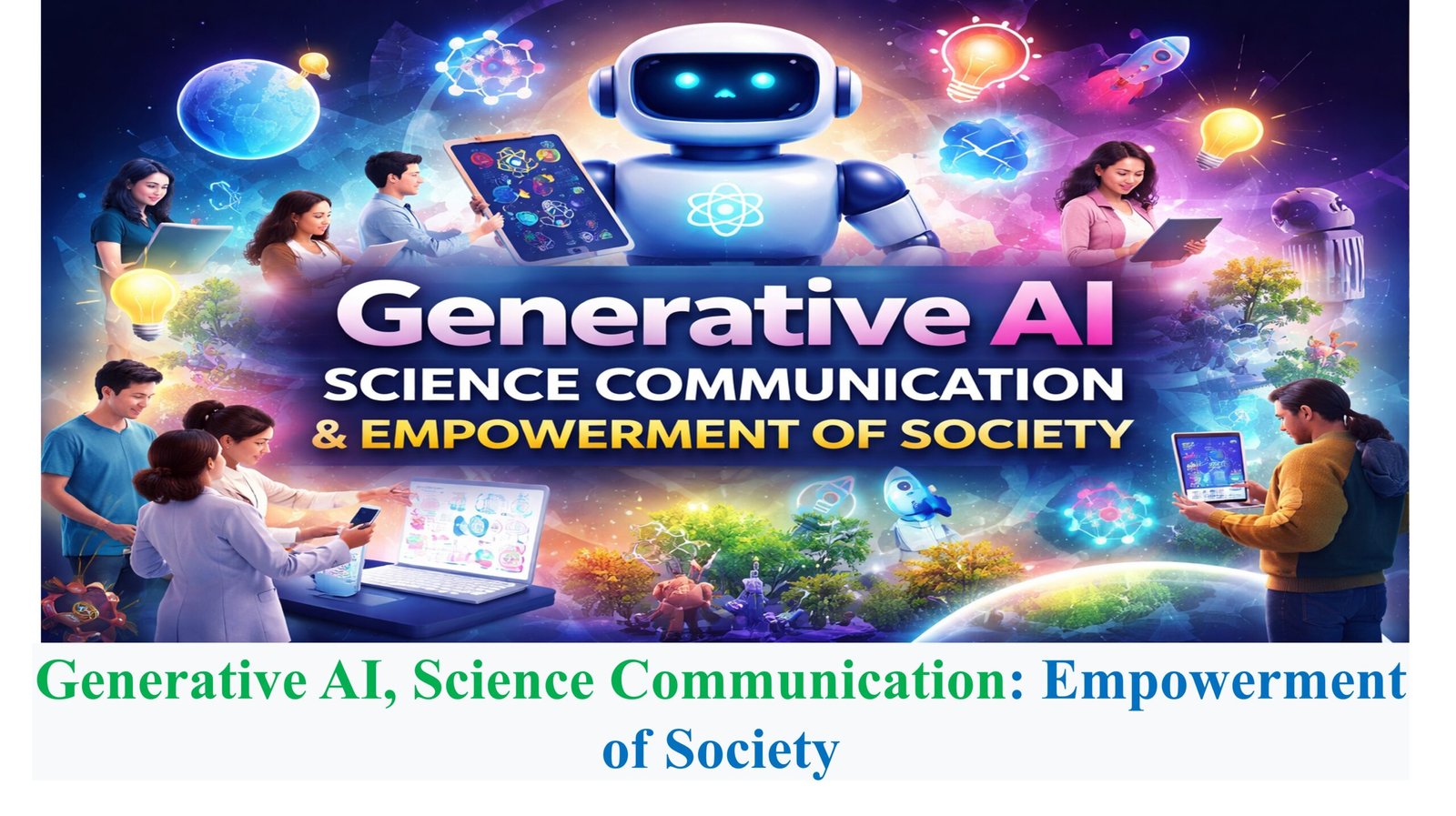
In the past, science communication largely remained within the boundaries of academic journals, classrooms, and expert conferences. Today, however, it has expanded far beyond these spaces—reaching millions through digital platforms, social media, podcasts, and interactive media. At the center of this transformation is a powerful and rapidly evolving technology: Generative Artificial Intelligence (Generative AI).
Tools such as ChatGPT, DALL.E, and Google Gemini are reshaping how scientific knowledge is created, interpreted, and shared. They are not only accelerating communication but also redefining the relationship between science and society. Yet, alongside these exciting possibilities come important challenges that must be addressed thoughtfully.
Understanding Generative AI
Generative AI refers to advanced artificial intelligence systems capable of creating new and original content—including text, images, audio, video, and even computer code—by learning patterns from vast datasets. Unlike traditional AI, which focuses primarily on analysis and prediction, generative AI produces outputs that often resemble human creativity.
In the context of science communication, this means complex scientific ideas can be simplified, visualized, and communicated in engaging and accessible ways for diverse audiences.
Opportunities in Science Communication
- Democratizing Access to Knowledge
One of the most transformative impacts of generative AI is its ability to make scientific knowledge widely accessible. It can translate complex research into simple language, generate summaries of technical papers, and provide multilingual content tailored to different audiences.
This is especially significant in a diverse country like India, where linguistic and educational barriers often limit access to scientific information.
- Enhancing Creativity and Engagement
Modern science communication is no longer just about presenting facts—it is about storytelling. Generative AI enables communicators to create visually rich and interactive content such as illustrations, animations, simulations, and infographics.
By transforming abstract concepts into relatable narratives, it makes science more engaging for students, educators, and the general public.
- Speed and Scalability
Generative AI dramatically increases the speed at which content can be produced and shared. Researchers and communicators can now generate multiple versions of content, tailor messages for specific audiences, and respond quickly to emerging developments.
This capability becomes particularly crucial during public health crises or environmental emergencies, where timely communication can save lives.
- Bridging the Gap Between Science and Society
A long-standing challenge in science has been the gap between experts and the general public. Generative AI helps bridge this divide by simplifying technical language, enabling conversational explanations, and supporting interactive formats like Q&A systems.
This fosters greater public understanding, trust, and informed decision-making.
Challenges and Concerns
- Risk of Misinformation
Despite its strengths, generative AI is not infallible. It can sometimes produce inaccurate or misleading information—often presented with confidence. In science communication, such errors can lead to confusion and erode public trust.
- Loss of Scientific Depth
While simplification improves accessibility, it can also result in the loss of important scientific nuances. Oversimplified content may ignore uncertainties, limitations, and context—key elements of scientific rigor.
- Ethical and Bias Issues
Since generative AI systems are trained on large datasets, they may inherit biases present in those datasets. This can lead to the unintentional reinforcement of cultural stereotypes, gender biases, or regional disparities in communicated content.
- Overdependence on AI
Excessive reliance on AI tools may weaken essential skills such as critical thinking, scientific writing, and interpretation. Human expertise remains central to meaningful science communication.
- Questions of Responsibility and Authorship
The rise of AI-generated content raises important questions: Who is accountable for inaccuracies? Who owns the content? These concerns are particularly relevant in sensitive domains like healthcare, environment, and public policy.
The Way Forward: Responsible Integration
To harness the full potential of generative AI, a balanced and ethical approach is essential:
- Human Oversight: AI should support, not replace, human expertise
- Fact-Checking: Verification of AI-generated content is critical
- Transparency: Clearly acknowledge the use of AI tools
- Ethical Frameworks: Develop guidelines for responsible use
- Capacity Building: Equip scientists and communicators with AI literacy
Conclusion
Generative AI is more than a technological advancement—it represents a paradigm shift in how science connects with society. It offers unprecedented opportunities to make science more inclusive, engaging, and impactful.
However, its true potential can only be realized when guided by responsibility, ethics, and human judgment. The future of science communication does not lie in replacing humans with machines, but in combining their strengths.
When used thoughtfully, generative AI can help build a more informed, curious, and scientifically empowered society.